
Yixing Clay 101
What is Yixing clay?
PO/ET Studio6 min read
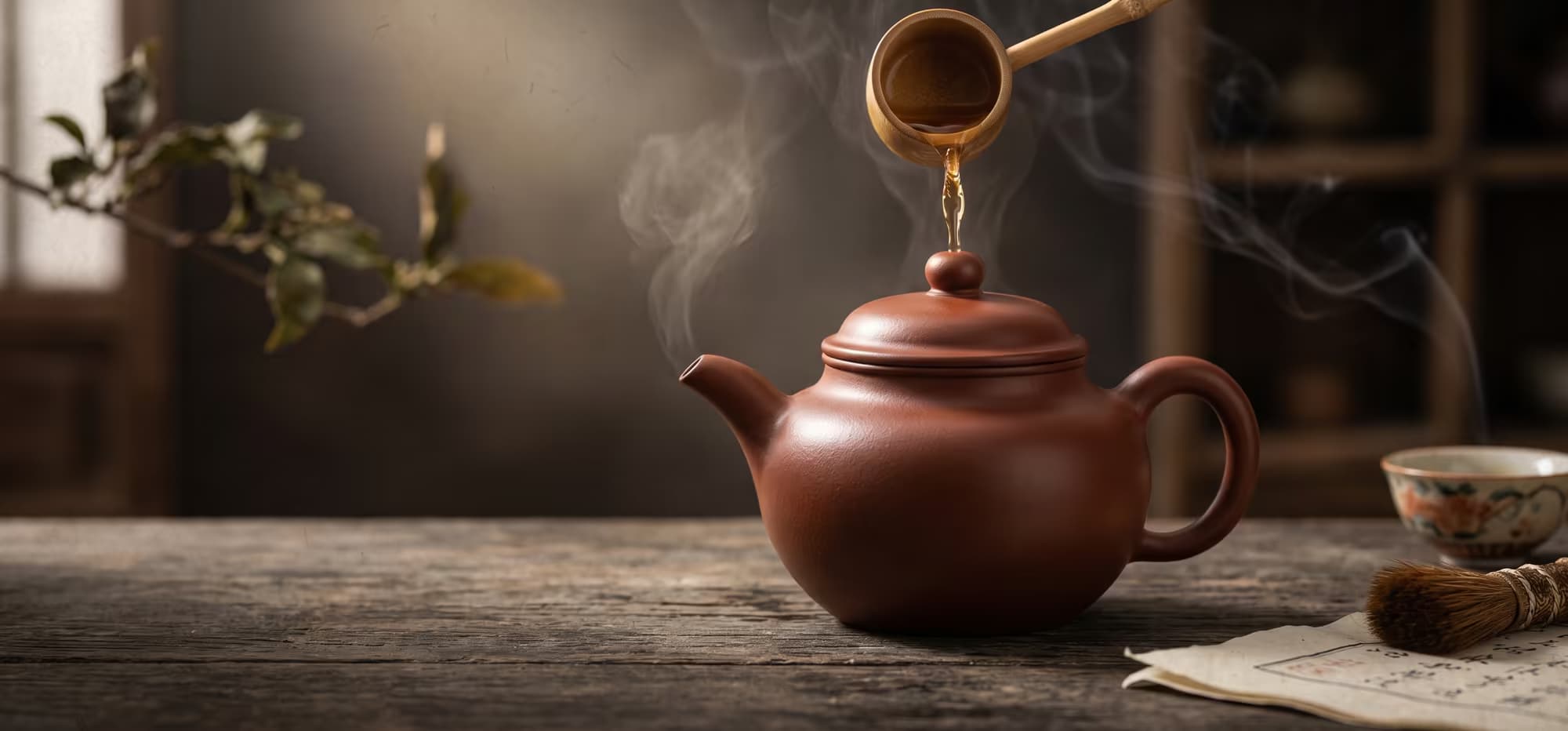
Yixing clay — zisha (紫砂), literally “purple sand” — is a mineral-rich stoneware quarried only around the city of Yixing in Jiangsu province, China. For more than 500 years it has been the clay of choice for gongfu teaware, and a genuine Yixing teapot is left unglazed so the bare clay can do its work.
If you have heard that a Yixing pot “remembers” your tea, this is why: the clay is what makes it special. Here is what zisha actually is, the main clay types you will see named on a teapot, and how to tell authentic Yixing clay from factory imitations.
Zisha: a stoneware, not a glaze
Zisha is a naturally occurring stoneware ore, mined as hard rock, then weathered, crushed, screened, and aged into a workable clay. Unlike porcelain or glazed pottery, a finished Yixing pot has no glassy coating. The surface you touch is the fired clay itself.
That bare surface is the whole point. Fired at roughly 1,100–1,200°C, zisha keeps an open network of tiny pores. The pot is watertight, but the walls can still breathe — absorbing a trace of tea oil and aroma with every brew. Over years a well-used pot becomes so saturated that, as the old saying goes, it can draw tea from nothing but hot water.
Why Yixing clay is prized for tea
Three properties make zisha the standard for serious tea drinkers. Its porosity rounds off harsh notes and carries aroma. Its dense body holds heat steadily through a long session, which suits oolong, pu-erh, and black teas. And because it seasons, a pot kept to one kind of tea slowly tunes itself to that tea — the reason collectors keep “one pot, one tea.”
The same clay is used for tea pets — small unglazed clay creatures kept on the tea tray and raised on leftover tea — which is why a tea pet develops the same deep patina as a seasoned pot.
The main Yixing clay types
Zisha is a family of clays, not one colour. Zi Ni (紫泥, purple clay) is the classic dense body — the workhorse of Yixing, firing a warm brown-purple. Di Cao Qing (底槽清) is a prized seam within the zi ni deposit at Huanglongshan, valued for its even, settled tone.
Zhu Ni (朱泥, cinnabar clay) is high in iron and fires a glowing oxblood red; it shrinks a lot in the kiln, so good zhu ni pots are harder to make and prized for it. Duan Ni (段泥) is a buff, sandy blend that fires from raw-biscuit beige toward honey and gold. Ben Shan Lü Ni (本山绿泥, ‘original-mountain green clay’) fires a pale greenish-beige. Each clay changes colour as it seasons.
Where real Yixing clay comes from
Authentic zisha is quarried near Dingshu, a town inside Yixing, with the most famous ore coming from Huanglongshan (Yellow Dragon Mountain). The region's particular mineral chemistry — high iron, quartz, and mica content — cannot be reproduced by mixing ordinary clay with dye, which is the line between a genuine Yixing pot and an imitation.
PO/ET teapots are made in Dingshu from clay selected and aged in the studio, then hand-thrown by master potter Xu Xuefang and signed with her seal.
Authentic vs. fake Yixing clay
Mass-market “Yixing” pots are often slip-cast in moulds from dyed ordinary clay, sometimes sealed with a glaze or shoe-polish sheen. Tell-tale signs of a fake: a suspiciously low price, a flawless mirror gloss straight out of the box, a strong chemical smell when rinsed with hot water, or colour that washes off.
A genuine handmade pot shows tool marks inside, a matte clay surface that develops shine only with use, and a maker's seal. Buy from a studio that names its clay and its maker — provenance is the surest test.